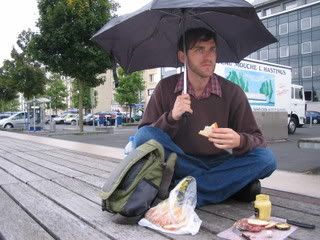
Last Friday I used a vacation day and drove up to San Francisco to hang out with my girlfriend Laura, who was already up there on a business trip. We spent a night at the excellent, out-of-the-way Marin Headlands Hostel (Laura works for Hosteling International in San Diego), visited my sister Kate, and did quite a bit of hiking, including a nice early evening walk through the redwood grove at Muir Woods.
Muir Woods is well known for its majestic grove of skyscraper redwoods. The path through it is flat, paved, and easy to walk. It is located in Marin County, just a short drive across the Golden Gate from San Francisco. It is, consequently, jam packed with tourists and daytripping locals on a sunny Saturday like the one Laura and I chose for our visit.
There were kids in strollers, kids walking, kids running, kids yelling. People talking in Spanish, Italian, German, English, and (I'm guessing here) at least four or five South Asian languages. Laura and I observed that the cathedral-like splendor of the grove was difficult to enjoy when the din from a group of fourteen Bengali students was competing with a family of six from Tennessee, with kids arguing about whether they could take their gathered redwood sticks home.
After an hour walk, as it was getting dusky and chilly, we were heading out, and happened to pass a brass plaque side of the path.
"Let's read the plaque," Laura said.
Never one to pass a plaque without reading, I walked over and read the inscription.
It indicated that in this spot, on May 19th 1946, representatives of the newly-formed United Nations came together to honor the memory of Franklin D. Roosevelt, who had died a month earlier. They chose this spot because it was so beautiful, and calm, and peaceful, the plaque said - a perfect place for reflection.
A kid shouted nearby as the mobs of people passed.
If only FDR could see this so-called "peaceful" spot today, I thought.
But then I looked around and realized that here, 61 years after FDR's death, which occurred before the conclusion of World War II, I could look around and see Germans, Italians, and Japanese, enjoying the California Redwoods side by side with Brits, Americans, Russians, and probably some French people, too. Not to mention the groups of Indians, Chinese, Mexicans, and representatives of who knows what other nations. And then I thought, yeah, if only FDR could see us now.
Monday, January 21, 2008

Wednesday, January 09, 2008
The Realest of the Real
It is now totally, 100 por ciento official. I have the tickets and they are non-refundable. So I have to either go on this trip or be out a few hundred bucks and have nothing to show for it. Laura and I are flying into Guadalajara on Palm Sunday - March 16th - and out of Oaxaca on April 6th, the day after Laura's birthday.
That means that we will be in Guadalajara, Guanajuato, and Morelia during Semana Santa - Holy Week, leading up to Easter. Parades, fiestas, and all sorts of good stuff.
A couple of months ago, Laura and I took a road trip to San Francisco, and made a stop at the Mission San Antonio de Padua outside Jolon in the area of central California that always makes me think of John Steinbeck. It was large, well preserved, and spartan. The cavernous, gloomy, wood-and-stucco buildings were home to bats, swallows, and suffering saints. A very unhappy looking Christ hung in the chapel, wonder why God had forsaken him. And Laura got more than a little freaked out. Something about austerity of the place combined with the severe iconography, and hit a chord in Laura, who went to Catholic school. We had to go.
I'm just hoping that all the intensity of Semana Santa doesn't hit the same chord.
That means that we will be in Guadalajara, Guanajuato, and Morelia during Semana Santa - Holy Week, leading up to Easter. Parades, fiestas, and all sorts of good stuff.
A couple of months ago, Laura and I took a road trip to San Francisco, and made a stop at the Mission San Antonio de Padua outside Jolon in the area of central California that always makes me think of John Steinbeck. It was large, well preserved, and spartan. The cavernous, gloomy, wood-and-stucco buildings were home to bats, swallows, and suffering saints. A very unhappy looking Christ hung in the chapel, wonder why God had forsaken him. And Laura got more than a little freaked out. Something about austerity of the place combined with the severe iconography, and hit a chord in Laura, who went to Catholic school. We had to go.
I'm just hoping that all the intensity of Semana Santa doesn't hit the same chord.
Wednesday, January 02, 2008
Guidebooks, Gifts, and the Reality of a Trip

Alright, I can't help myself; I'm going to trot out the tired old junkie metaphor. I need my fix. Pantomime of slapping the vein. I am badly jonesing for travel. I came back from my last real trip just over a year ago - so long, I fear I may start seeing dead babies crawling towards me on the ceiling.
But I have a hookup! My girlfriend Laura and I have been talking about traveling together for a while now, so for X-mas, I gave her plane tickets to Mexico - into Monterrey, out of Oaxaca. A 3-week trip. Actually, I gave her the promise of plane tickets in the future, once we work out firmer dates and itineraries. And I gave here the Lonely Planet Mexico, and bought the Rough Guide for myself. That's the biggest initial step towards turning travel daydreams into reality - the purchase of a guidebook. Then you exit the daydream stage, and enter the planning stage. Then when you buy tickets, you are officially going. Coming soon...
Sunday, November 04, 2007
Ad Hoc Construction by Buena Vista Park
I'm writing this from my sister Kate's basement level apartment by Buena Vista Park in San Francisco. It's a cozy yet bizarre little space on the ground floor of an old Victorian from the 1880s. The apartment is kind of a studio, since there is only one main room, but the main room is large, and broken in half by a big archway that, judging from the hinges mounted on it, contained double doors at some point. The door to her bathroom has about eight inches of space between its bottom and the floor, and, strangest of all, contains only the sink and claw-foot bathtub. To reach the toilet, you leave the bathroom by another door, and walk down a crooked, red-carpeted hallway, that is also the back entrance to her neighbor's apartment. The toilet is in a small closet across this hall. It is not shared - it is Kate's toilet - it is just located across communal hallway.
This place has been around for 120 years or so, and in that time, I'm sure that the usage and layout of the space that is now Kate's apartment has changed many times. Remodels, renovations, reallocations of space - each time one of these is done, you have to deal with the space as it is, and many decisions are made ad hoc. And then, suddenly, a century later, you find that the toilet has to be down the hall and the door doesn't reach the floor. Much as we Californians would like to believe that we can rebuild ourselves as whatever we want, wherever we choose, our choices are necessarily a product of the choices of those who came before.
And in a weird, those-who-came-before-you coincidence, Kate's new San Francisco apartment is five or six doors down from the house my grandmother grew up in. It was the house she lived in when she rode the ferry across the bay to Berkeley, as the Bay Bridge was being built, and the house my dad remembers visiting to see his grandmother after the Keller family moved down to San Diego. But now my sister Kate has graduated from Berkeley, and has decided that she likes the Bay Area better than San Diego, and has made this apartment her little corner of the City. It has taken a hundred years and three generations, but a Keller has come full circle.
I'm still undecided as to whether full circle represents a lack of progress, or an all-is-one sort of transcendence. All I know is that Kate and I are made of the same stuff as our ancestors, but we've also undergone a lot of ad hoc construction.
This place has been around for 120 years or so, and in that time, I'm sure that the usage and layout of the space that is now Kate's apartment has changed many times. Remodels, renovations, reallocations of space - each time one of these is done, you have to deal with the space as it is, and many decisions are made ad hoc. And then, suddenly, a century later, you find that the toilet has to be down the hall and the door doesn't reach the floor. Much as we Californians would like to believe that we can rebuild ourselves as whatever we want, wherever we choose, our choices are necessarily a product of the choices of those who came before.
And in a weird, those-who-came-before-you coincidence, Kate's new San Francisco apartment is five or six doors down from the house my grandmother grew up in. It was the house she lived in when she rode the ferry across the bay to Berkeley, as the Bay Bridge was being built, and the house my dad remembers visiting to see his grandmother after the Keller family moved down to San Diego. But now my sister Kate has graduated from Berkeley, and has decided that she likes the Bay Area better than San Diego, and has made this apartment her little corner of the City. It has taken a hundred years and three generations, but a Keller has come full circle.
I'm still undecided as to whether full circle represents a lack of progress, or an all-is-one sort of transcendence. All I know is that Kate and I are made of the same stuff as our ancestors, but we've also undergone a lot of ad hoc construction.
Wednesday, August 15, 2007
Creativity
My creative energy has been sloping off for a while now, and this disturbs me. Back in high school, and immediately post-high school, I averaged 4 or 5 plays a year. That's pretty good. Then later it sloped off to two or three. Last year, I acted in one show, and, as I recall, did music for one. Unacceptable. I am in withdrawals from my 5 play a year habit.
Wednesday, August 08, 2007
Uncle Dave Macon Days
Holy Hell, I love Uncle Dave Macon.
The entirety of what I knew about him was two tracks from the Anthology of American Folk, but I have recently discovered that there is now a 4-CD of his recordings.
His ouvre is about half songs about his love for Jesus, and half songs like Old Plank Road, about cheatin' women and getting drunk. Just fun, energetic music. My favorite Uncle Dave lyric:
My wife died last Friday night,
Saturday she was buried.
Sunday was my courtin' day,
Monday I got married.
An amazing factoid: Uncle Dave began his career as a musician at age 50, in the year 1920. Up to that point, he had been a farm and played the banjo as a hobby.
Do yourself a favor - check out Uncle Dave.
The entirety of what I knew about him was two tracks from the Anthology of American Folk, but I have recently discovered that there is now a 4-CD of his recordings.
His ouvre is about half songs about his love for Jesus, and half songs like Old Plank Road, about cheatin' women and getting drunk. Just fun, energetic music. My favorite Uncle Dave lyric:
My wife died last Friday night,
Saturday she was buried.
Sunday was my courtin' day,
Monday I got married.
An amazing factoid: Uncle Dave began his career as a musician at age 50, in the year 1920. Up to that point, he had been a farm and played the banjo as a hobby.
Do yourself a favor - check out Uncle Dave.
Tuesday, August 07, 2007
Do I Look Like a Stephanie?
My dad found a badge to the Siggraph convention laying on the sidewalk on 4th ave this afternoon, and suggested that I take it and do a spin around the San Diego Convention Center. So I walked down to the end of the Gaslamp Quarter, put the badge around my neck, and became Stephanie Simpson.
Con-Vis security guards, as it turns out, don't really give a crap whether you look like a Stephanie. They mostly care if you have a plastic pouch slung around your neck.
Holy crap, that thing is cool. People demoing software for designing CG models - one guy was putting the finishing touches on a shockingly lifelike 3D dinosaur man's armor, as fifteen or twenty spectators watched. People demoing mo-cap suits and software (most people, when they get a chance to get their motion captured, do a strange, awkward sort of dance.), including mo-cap that does not require a spandex suit with ping-pong balls on it, since it can capture any motion at all, including the motion of facial expressions. There was even a Lucasfilm booth, with a huge crowd watching a guy explain how they made the Transformers transform.
Wicked cool. Sorry Stephanie.
Con-Vis security guards, as it turns out, don't really give a crap whether you look like a Stephanie. They mostly care if you have a plastic pouch slung around your neck.
Holy crap, that thing is cool. People demoing software for designing CG models - one guy was putting the finishing touches on a shockingly lifelike 3D dinosaur man's armor, as fifteen or twenty spectators watched. People demoing mo-cap suits and software (most people, when they get a chance to get their motion captured, do a strange, awkward sort of dance.), including mo-cap that does not require a spandex suit with ping-pong balls on it, since it can capture any motion at all, including the motion of facial expressions. There was even a Lucasfilm booth, with a huge crowd watching a guy explain how they made the Transformers transform.
Wicked cool. Sorry Stephanie.
Monday, July 30, 2007
An Erosion of Interstate Values?

There is a section of freeway in the San Francisco Bay Area that is both the I-80 East and I-580 West. When you drive on this freeway, you are headed almost due North. This must certainly be fundamentally damaging traditional definitions of East and West, and undermining the sanctity of our cardinal directions. Or perhaps the Bay Area should be applauded for liberating itself from the tyranny of arbitrary definitions of directions based on some invisible force. Direction is just wherever you go! Don't oppress me with your magnetic fields.
Saturday, July 28, 2007
Best... Cioppino... Everrr...
So, again I have to resist my genetic predisposition towards describing the minutia of my travel day. The way we hit the road from El Cajon at 4:25am. Headed up the 52, to the 805. Then from the 5 to the 101 as we came down out of the Sepulveda Pass into the Valley, 101 up through--
No! Must... not... bore readers...
Fast forward to the afternoon.
We took the 183 out of Salinas. Passed the National Steinbeck Center (they have Rocinante, right there in the building!), into Castroville. Resisted the urge to stop at the Giant Artichoke. Then down to the coast and into Moss Landing.
There are two distinctive features of Moss Landing, CA. One is a pair of giant smokestacks at a power station of some sort. The other is Phil's Fish Market and Eatery. (The snazzy website with flash animation belies the funkiness of the place a bit. Rest assured, you won't need to wear a tie.)
If you don't know where you're going, you have no chance of stumbling on Phil's. If you do know where you're going, you have a chance, but it's a long shot. The road twists through the Moss Landing marina, past all sorts of industrial-looking buildings and boats, with sea lions barking in the background, until finally you see Phil's.
But that is not the right Phil's.
You have found Phil's Lunch Shack, or Phil's Snack Shack, or something like that. Same Phil, different business. What you want to do now is turn down the least promising-looking road you can, and drive past a bunch of warehouses and docks. The actual Phil's is down there, on the left.
Phil's Fish Market and Eatery lives in a big warehousey type building, with a menu on dry-erase whiteboards that stretch all the way to the cavernous ceiling. There is indeed a full-on fish market in the front, and, as with any respectable fish seller, it does not smell remotely like fish. Just kind of briny.
The food is fresh and there is plenty of it. You can't take a forkful your grilled halibut without having a little salad and rice pilaf spill off the side of the plate. At least I can't. Maybe you can.
The specialty is a huge pot of thick cioppino, full of mussels, clams, &c., that looks like a big helping of primordial ooze with sourdough bread for dipping. I am not very good at those food-writer type fawning descriptions of taste, so I will just say that it is muthaf@kin' AWESOME. Worth a several hour detour the next time you are traveling through central California.
No! Must... not... bore readers...
Fast forward to the afternoon.
We took the 183 out of Salinas. Passed the National Steinbeck Center (they have Rocinante, right there in the building!), into Castroville. Resisted the urge to stop at the Giant Artichoke. Then down to the coast and into Moss Landing.
There are two distinctive features of Moss Landing, CA. One is a pair of giant smokestacks at a power station of some sort. The other is Phil's Fish Market and Eatery. (The snazzy website with flash animation belies the funkiness of the place a bit. Rest assured, you won't need to wear a tie.)
If you don't know where you're going, you have no chance of stumbling on Phil's. If you do know where you're going, you have a chance, but it's a long shot. The road twists through the Moss Landing marina, past all sorts of industrial-looking buildings and boats, with sea lions barking in the background, until finally you see Phil's.
But that is not the right Phil's.
You have found Phil's Lunch Shack, or Phil's Snack Shack, or something like that. Same Phil, different business. What you want to do now is turn down the least promising-looking road you can, and drive past a bunch of warehouses and docks. The actual Phil's is down there, on the left.
Phil's Fish Market and Eatery lives in a big warehousey type building, with a menu on dry-erase whiteboards that stretch all the way to the cavernous ceiling. There is indeed a full-on fish market in the front, and, as with any respectable fish seller, it does not smell remotely like fish. Just kind of briny.
The food is fresh and there is plenty of it. You can't take a forkful your grilled halibut without having a little salad and rice pilaf spill off the side of the plate. At least I can't. Maybe you can.
The specialty is a huge pot of thick cioppino, full of mussels, clams, &c., that looks like a big helping of primordial ooze with sourdough bread for dipping. I am not very good at those food-writer type fawning descriptions of taste, so I will just say that it is muthaf@kin' AWESOME. Worth a several hour detour the next time you are traveling through central California.
Thursday, July 26, 2007
Sing, Muse, of State Route 80
Tomorrow, I will get up at 4am, get in my parents' Volkswagen Passat, and head up the 5 towards San Francisco. We'll head up through Gorman in the Tejon Pass, where we will switch drivers, and then cut off the interstate somewhere in the Central Valley - maybe the 46 down into Paso Robles, maybe the 198 through Coalinga to the 25, winding through the San Benito Valley...
Just writing that intro makes me feel like I'm chanting the beginning of some ancient epic. I can almost hear the drumming and the crackle of the campfire.
Nearly every story my dad tells about his youth begins like this.
"We loaded up the '59 Ford wagon and left before dawn. Headed out route 80 through Descanso, and Pine Valley, and had breakfast at the Space Age Lodge in Gila Bend" - my dad remembers things like where he had breakfast on a certain day in 1962 - "crossed into New Mexico, then over the Rio Grande at midnight..."
I'm sure that back in Germany, hundreds of years ago, there was some Keller telling his kids about loading up the old wagon, hitching the mule, and heading down towards Stuttgart. And hundreds of years from now, some Keller will be talking about loading up the old flying car...
Just writing that intro makes me feel like I'm chanting the beginning of some ancient epic. I can almost hear the drumming and the crackle of the campfire.
Nearly every story my dad tells about his youth begins like this.
"We loaded up the '59 Ford wagon and left before dawn. Headed out route 80 through Descanso, and Pine Valley, and had breakfast at the Space Age Lodge in Gila Bend" - my dad remembers things like where he had breakfast on a certain day in 1962 - "crossed into New Mexico, then over the Rio Grande at midnight..."
I'm sure that back in Germany, hundreds of years ago, there was some Keller telling his kids about loading up the old wagon, hitching the mule, and heading down towards Stuttgart. And hundreds of years from now, some Keller will be talking about loading up the old flying car...
Wednesday, July 18, 2007
Panels! Panels!
Once more, I will attempt to resuscitate this blog. I have developed a bit of a pattern, I must say - one post about every two and a half months. But this time it's different, I swear. Baby, I'm a changed man. You can now expect posts to appear weekly - no, daily! Daily? No, hourly! Why not! Hourly posts from yours truly, about whatever whim strikes my fancy. So. Here's the whim:
Humm... No whim coming... Better improvise-
I know. Random subjects.
I keep a notebook. One of those little Moleskine dealies with the black cover and the built-in rubber band. (Why, you ask, do I keep a notebook? When I seldom if ever write or do anything as a result of those notes? A good question. Maybe one day, I'll write about that. In fact, I'll make a note to do so in my Moleskine right now.) I'll flip to a random page, and write about the note.
Here's the random note:
"I may be imagining this, but I always perceive a veiled hostility in the service in poor countries. Or maybe I'm just projecting my own guilt."
I have no recollection of the specific events that prompted this note.
But I do have a general recollection of... well, not of any specific events at all, but of an interaction which is likely a composite of many actual events I have experienced while traveling.
I am sitting in a restaurant. Its walls are dirty, bare concrete, and one features a poster of a Hindu god, or the King of Thailand, or perhaps a ripped shirtless Aztec cradling a voluptuous woman in his arms. There is a young waiter, and his demeanor (I talk about his demeanor because I can't remember the details. A good writer would describe his face or the position of his shoulders, but I describe his demeanor because I remember my impression of him, but not him actually.) - his demeanor was a strange admixture of obsequious and diffident...
Or it's a hotel. And there is a concierge. Or a bellhop. He wears a dingy uniform, or maybe just his own shirt - one of the two he owns. I know he resents me for parading my wealth in front of him - a backpack overflowing with shirts, ten, twenty, maybe fifty shirts. A shirt for every day of my life, to be used and discarded that evening. This is what he is thinking. I can sense it.
Humm... No whim coming... Better improvise-
I know. Random subjects.
I keep a notebook. One of those little Moleskine dealies with the black cover and the built-in rubber band. (Why, you ask, do I keep a notebook? When I seldom if ever write or do anything as a result of those notes? A good question. Maybe one day, I'll write about that. In fact, I'll make a note to do so in my Moleskine right now.) I'll flip to a random page, and write about the note.
Here's the random note:
"I may be imagining this, but I always perceive a veiled hostility in the service in poor countries. Or maybe I'm just projecting my own guilt."
I have no recollection of the specific events that prompted this note.
But I do have a general recollection of... well, not of any specific events at all, but of an interaction which is likely a composite of many actual events I have experienced while traveling.
I am sitting in a restaurant. Its walls are dirty, bare concrete, and one features a poster of a Hindu god, or the King of Thailand, or perhaps a ripped shirtless Aztec cradling a voluptuous woman in his arms. There is a young waiter, and his demeanor (I talk about his demeanor because I can't remember the details. A good writer would describe his face or the position of his shoulders, but I describe his demeanor because I remember my impression of him, but not him actually.) - his demeanor was a strange admixture of obsequious and diffident...
Or it's a hotel. And there is a concierge. Or a bellhop. He wears a dingy uniform, or maybe just his own shirt - one of the two he owns. I know he resents me for parading my wealth in front of him - a backpack overflowing with shirts, ten, twenty, maybe fifty shirts. A shirt for every day of my life, to be used and discarded that evening. This is what he is thinking. I can sense it.
Tuesday, April 17, 2007
God Bless the Digital Age
One thing about the Digital Age, it allows us to procrastinate to an unprecedented degree.
I just filed my 2006 tax return with a whole 80 minutes to spare. Thanks to the wonders of e-file, I was able to work all day, eat a flank steak, drink a beer, and watch much of "the Waterboy" before finally rendering unto Caesar at 10:20pm on the day it's due. Technology and procrastination - two great tastes that taste great together.
I just filed my 2006 tax return with a whole 80 minutes to spare. Thanks to the wonders of e-file, I was able to work all day, eat a flank steak, drink a beer, and watch much of "the Waterboy" before finally rendering unto Caesar at 10:20pm on the day it's due. Technology and procrastination - two great tastes that taste great together.
Thursday, February 22, 2007
Itchy Feet
I'm getting that antsy, itchy-feet feeling that means I'm going to have to travel again soon. I swear, it's some kind of disorder. I can't stop. Where to this time? I've never been to South America - Argentina, maybe? Or South Africa? There's always good ol' Thailand, never done me wrong before....
Wednesday, January 31, 2007
I can't go on, I'll go on.
Well, I like the general concept of blogging, but I rarely feel as if I have anything that deserves to be put out there into the great collective unconscious that is the internets, except, of course, for when I'm traveling. Travel days are so rich with stories that it's easy to pick one or two that are interesting enough to share. But what about my prosaic life? I don't know. Shall I report to you that I worked for 8 hours, came home, drank a glass of bourbon and ate some raw broccoli dipped in Hidden Valley Ranch dressing? Is that worthy of putting into type? Who the fuck knows.
But for some strange reason, I am now, two months after the end of my last trip, driven to type words and have them appear on the world-renowned Pomo Boho Hobo blog.
But for some strange reason, I am now, two months after the end of my last trip, driven to type words and have them appear on the world-renowned Pomo Boho Hobo blog.
Friday, November 24, 2006
Please Tell Your Friends We Do Not Hate Them
This is what a guy in Old Cairo told me yesterday. He had struck up a conversation with the usual, "Where are you from," and, when I said I was from America, he asked if I liked Egypt and whether I found people to be friendly. I said that the people are extremely friendly. That's when he asked that I tell this to people in America.
"Tell them we do not hate them," he said. "I will be honest with you; we hate Bush. But we do not hate American people."
So today, the last day of my trip, that is what I'm doing. People of America, know this; the people of Egypt do not hate you.
I have had countless random people on the street tell me some variation of this. We hate Bush, but you are welcome to Egypt.
Egypt really is unbelievably friendly. Some of the friendliness morphs into hustle, particularly in Cairo, where your new friend is often trying to get you to visit his papyrus painting shop or craft store.
In Alexandria, however, the hospitality is nearly always genuine, and so omnipresent that I literally would not have had the time to accept each offer.
I was walking by an old tea shop along the Corniche in front of Alexandria's Eastern Harbor, when an old man sitting by the window yelled, "Hello! Where are you from?"
I responded.
"Ah," he said, "America! I have been to Boston, to New York, to Charleston. Come inside."
I hesitated a moment.
"Come inside!" he ordered, obviously impatient with my vacillating.
I went into the tea shop, a large, wood-paneled room with high ceilings, overhead fans, and big, open windows looking out on the harbor. It was full of old Egyptian men drinking tea, telling stories, arguing, smoking bubbling sheesha water pipes, or, often, just quietly gazing out at the water.
My host introduced himself as Captain Sayeed, a retired sailor in the Egyptian merchant marine. He had sailed to ports all around the world, but loved his time in the USA - a beautiful country he said, with wonderful people.
Captain Sayeed had the posture and manner of a man accustomed to giving orders and having them obeyed. But he also listened intently to every word that I said when we were speaking. We sat and drank tea for well over an hour. Whenever something struck him as funny, or when he felt that he had made a particularly trenchant comment, he would throw back his head and laugh a loud, hoarse laugh.
When I finally graciously took my leave, Captain Sayeed demanded that I return the next day. He sat in that spot, in that cafe, every day from about 9am to 2pm. I could find him there. I agreed, and as I am a man of my word, I showed up for more tea the next day. Though, truth be told, my morning tea with the Captain was the highlight of my Alexandrian day. There's no way I would have missed it.
"Tell them we do not hate them," he said. "I will be honest with you; we hate Bush. But we do not hate American people."
So today, the last day of my trip, that is what I'm doing. People of America, know this; the people of Egypt do not hate you.
I have had countless random people on the street tell me some variation of this. We hate Bush, but you are welcome to Egypt.
Egypt really is unbelievably friendly. Some of the friendliness morphs into hustle, particularly in Cairo, where your new friend is often trying to get you to visit his papyrus painting shop or craft store.
In Alexandria, however, the hospitality is nearly always genuine, and so omnipresent that I literally would not have had the time to accept each offer.
I was walking by an old tea shop along the Corniche in front of Alexandria's Eastern Harbor, when an old man sitting by the window yelled, "Hello! Where are you from?"
I responded.
"Ah," he said, "America! I have been to Boston, to New York, to Charleston. Come inside."
I hesitated a moment.
"Come inside!" he ordered, obviously impatient with my vacillating.
I went into the tea shop, a large, wood-paneled room with high ceilings, overhead fans, and big, open windows looking out on the harbor. It was full of old Egyptian men drinking tea, telling stories, arguing, smoking bubbling sheesha water pipes, or, often, just quietly gazing out at the water.
My host introduced himself as Captain Sayeed, a retired sailor in the Egyptian merchant marine. He had sailed to ports all around the world, but loved his time in the USA - a beautiful country he said, with wonderful people.
Captain Sayeed had the posture and manner of a man accustomed to giving orders and having them obeyed. But he also listened intently to every word that I said when we were speaking. We sat and drank tea for well over an hour. Whenever something struck him as funny, or when he felt that he had made a particularly trenchant comment, he would throw back his head and laugh a loud, hoarse laugh.
When I finally graciously took my leave, Captain Sayeed demanded that I return the next day. He sat in that spot, in that cafe, every day from about 9am to 2pm. I could find him there. I agreed, and as I am a man of my word, I showed up for more tea the next day. Though, truth be told, my morning tea with the Captain was the highlight of my Alexandrian day. There's no way I would have missed it.
Saturday, November 18, 2006
Mohammed Cramps My Bargaining Style

I was having some trouble finding my seat on the bus from Nuweiba to Cairo. The numbers were only in Arabic, which takes me a moment or two to puzzle out, and in my moment of puzzling, a young Egyptian guy with lots of curly hair stepped forward to help me. (This happens all the time - people here are always ready to help a dumb foreigner figure stuff out.)
My seat, however, appeared to already be occupied by some guy's sweater and water bottle. In Arabic, the kid who was helping me told the guy, (I'm assuming here) something along the lines of, "This is the dumb foreigner's seat. Can you move your sweater and water bottle?"
The guy said something which could only have been an answer in the negative, and then turned back to his window. There was more discussion, with a couple of other passengers throwing in their two cents, and the guy giving curt answers and turning back to the window. Maybe he had a friend who wanted to sit there. Maybe he just didn't want to sit next to the foreigner. I may never know.
I glanced back to look for open seats. Two different guys gestured to the open seats next to them. The one I ended up sitting next to was named Mohammed - but he said to call him Moe.
Moe works in Saudi Arabia as the communications manager for a Saudi prince who wants to set up a TV station. He was on his way back to Cairo to visit his family. But the main thing he wanted to talk about was, of all things, his time spent working in Dahab (q.v. my post Dahab and the Egyptian Mafia). This mostly involved detailed stories of his many foreign girlfriends, and his love of tearing around the Sinai in a fast car with a bottle of whiskey and at least one beautiful girl.
As we rolled into Cairo, I asked Moe how much I should pay for a taxi from the bus station to my hotel. An old technique - if you don't want to get ripped off, ask a local how much they would pay.
He said, "I don't know, probably a lot. You're a tourist, so you'll probably have to pay fifty."
Fifty Egyptian Pounds for a cab ride anywhere in Cairo is extortion. A ridiculously high rate. (Nevermind that it's under ten bucks.)
"But," Moe said, "I will help you get a taxi."
We got off the bus, he greeted his family, I gathered my luggage. As per usual, I was beset by offers of taxis. Of course, the first guy wanted fifty.
"Twenty," I said.
"No, no very far away!" It wasn't far away. It was less than 6km. I started to walk to the next guy.
"Okay, thirty-five." Progress.
"Okay, twenty-five," I said.
"Let's go."
Then Moe walked up. He pat me on the back, said how much he enjoyed my company, gave me his cell phone number and said to call if I needed anything in Cairo. He helped me carry my backpack to a different taxi.
"This guy will take you. I've worked it all out for you," Moe said.
I thanked him profusely, and got in the car.
"Okay, you can pay this man fifty when you get to the hotel. See you later!"
And the car tore off into the vicious hurly-burly of Cairo traffic. Moe had just assumed that, as a tourist, I would have to pay tourist rates. I don't know what is the morally right thing to do in this situation. Suck it down and pay many times what a local would, because I'm from a rich country? (An Egyptian guy at my hotel said he would have paid ten, fifteen tops.) Should I try to get the dirt cheapest price I can? Is there, perhaps, a happy medium? I don't know. All I know is that my cabbie, who had overheard my bargaining, was grinning like a madman for the entire drive.
My seat, however, appeared to already be occupied by some guy's sweater and water bottle. In Arabic, the kid who was helping me told the guy, (I'm assuming here) something along the lines of, "This is the dumb foreigner's seat. Can you move your sweater and water bottle?"
The guy said something which could only have been an answer in the negative, and then turned back to his window. There was more discussion, with a couple of other passengers throwing in their two cents, and the guy giving curt answers and turning back to the window. Maybe he had a friend who wanted to sit there. Maybe he just didn't want to sit next to the foreigner. I may never know.
I glanced back to look for open seats. Two different guys gestured to the open seats next to them. The one I ended up sitting next to was named Mohammed - but he said to call him Moe.
Moe works in Saudi Arabia as the communications manager for a Saudi prince who wants to set up a TV station. He was on his way back to Cairo to visit his family. But the main thing he wanted to talk about was, of all things, his time spent working in Dahab (q.v. my post Dahab and the Egyptian Mafia). This mostly involved detailed stories of his many foreign girlfriends, and his love of tearing around the Sinai in a fast car with a bottle of whiskey and at least one beautiful girl.
As we rolled into Cairo, I asked Moe how much I should pay for a taxi from the bus station to my hotel. An old technique - if you don't want to get ripped off, ask a local how much they would pay.
He said, "I don't know, probably a lot. You're a tourist, so you'll probably have to pay fifty."
Fifty Egyptian Pounds for a cab ride anywhere in Cairo is extortion. A ridiculously high rate. (Nevermind that it's under ten bucks.)
"But," Moe said, "I will help you get a taxi."
We got off the bus, he greeted his family, I gathered my luggage. As per usual, I was beset by offers of taxis. Of course, the first guy wanted fifty.
"Twenty," I said.
"No, no very far away!" It wasn't far away. It was less than 6km. I started to walk to the next guy.
"Okay, thirty-five." Progress.
"Okay, twenty-five," I said.
"Let's go."
Then Moe walked up. He pat me on the back, said how much he enjoyed my company, gave me his cell phone number and said to call if I needed anything in Cairo. He helped me carry my backpack to a different taxi.
"This guy will take you. I've worked it all out for you," Moe said.
I thanked him profusely, and got in the car.
"Okay, you can pay this man fifty when you get to the hotel. See you later!"
And the car tore off into the vicious hurly-burly of Cairo traffic. Moe had just assumed that, as a tourist, I would have to pay tourist rates. I don't know what is the morally right thing to do in this situation. Suck it down and pay many times what a local would, because I'm from a rich country? (An Egyptian guy at my hotel said he would have paid ten, fifteen tops.) Should I try to get the dirt cheapest price I can? Is there, perhaps, a happy medium? I don't know. All I know is that my cabbie, who had overheard my bargaining, was grinning like a madman for the entire drive.
Sunday, November 12, 2006
Dahab and the Egyptian Mafia
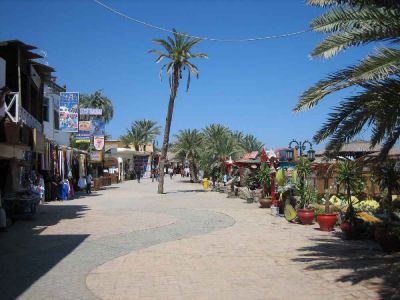
When we checked into our hotel in Dahab, a Sinai beach town with a hippyish backpacker feel, there were three young Egyptian guys behind the counter screwing around. One turned to us, grinned and introduced himself and his friends. They were the Egyptian Mafia - the guy at the end of the line, tall, with curly hair and a cell phone in his hand was the Drug Dealer. Then next one, wearing a slick, Ben Shermanesque shirt with three buttons open, was the Killer.
"And me, I'm the Don."
They all laughed. More general screwing around ensued, jokes flying from all sides, in English and Arabic, and they got us checked in at a leisurely pace.
The restaurant at the Sphinx hotel is called the Funny Mummy. This is where Lee and I eat breakfast every day, facing the Gulf of Aqaba, sitting on comfy cushions on the floor. This is how we were welcomed to the Funny Mummy on our first day:
A guy with a mustache, who we had not yet met, came casually over to the table with a couple of menus, and said, "Good morning my friends! Where you come from?"
I said, "California." I usually say California rather than America. Everybody has heard of California, and it seems somehow hipper.
"Ah, Americans! You are welcome. Fuck Bush." He gave a sardonic yet friendly half-way grin and walked off to get us some coffee. Then one of the Mafia came over and sat next to us.
He said, "Good morning," and leaned way back on the cushions, checking his cell phone. He looked tired.
"Too much party last night." As he typed out a text message with his thumb, he explained that he had stayed out late at a club, and had to work this morning at 7am.
We've now been in Dahab for four days, and have gotten to know by sight and brief repartee a number of the guys who stand in front of bars and restaurants and try to rope in tourists. Their lines vary from, "Please come see the menu," to "Did you hear the joke about the hippy and the nun?" It's a form of the Hustle, which is pretty much omnipresent in the parts of Egypt tourists frequent, but this hustle is always done with an easygoing sense of fun.
Last night, Saturday night, we went to a party at the Tota Bar, the front of which resembles an old clipper, complete with portholes and a rigged mast. Crunchy, thumping Trance filled the bar, and tourists danced in the middle. Out back people hung out around fires, and drank beer. The bar/restaurant hustlers mingled, played pool, and put their verbal skills to use hitting on the foreign girls. Working in Dahab must be many a swinging young Egyptian's dream.
Saturday, November 04, 2006
The Last Remaining Wonder of the Ancient World

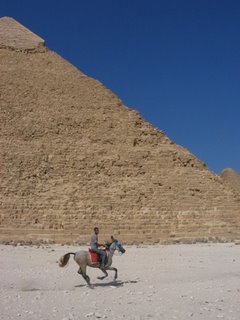
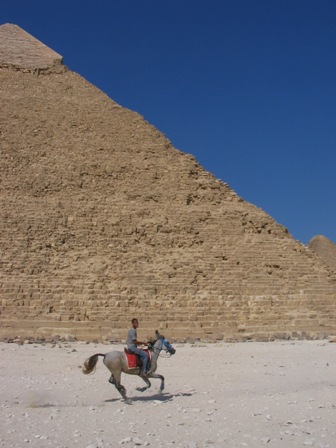
Yesterday we went to the Giza plateau, 30 km from downtown Cairo, and spent the day in the presence the pyramids of Khufu, Kafre and Menkaure. They have been visited, and written about, by travelers from Herodotus to Mark Twain, so it is a bit daunting to attempt say something about them. Here are a few observations:
- At 4000 years old, the Great Pyramid of Khufu is the oldest of the Seven Wonders of the Ancient World - nearly two millenia older than its nearest competitor, the Hanging Gardens of Babylon. It is also the only Wonder that is still in existence.
- The Giza Plateau is full of tourists and persistent hustlers offering horse and camel rides, tours, and sovenirs. The pyramids are still one of the most awesome things I have ever seen.
- The Cairo suburb of Giza comes right up to the foot of the Giza Plateau. If you look one direction from the pyramids, you see desert. If you look the other, you see the smog and sprawl of a city with 20 million inhabitants.
- There is a KFC at the bottom of the plateau. The Sphinx's inscrutable gaze appears to be locked with that of the grinning Colonel.


Monday, October 30, 2006
Again With the Hustle
We met Omar on the train from Meknes to Fes. He struck up a conversation with the usual, "Where are you from," and then told us about his family in Fes, and his job at the Roman ruins of Volubilis, near Meknes. We told him about our lives and families. His English was great, and he had us break out our Lonely Planet so he could show us his favorite places in Fes. And somewhere in the back of my mind, a little voice kept asking, "Are we being hustled?"
The Hustle is everywhere in Morocco. Walk into the medina of any city, and suddenly you are the center of attention. Where are you from? Welcome to my country. Would you like some tea? Do you need a guide? A carpet? Hashish? Would you like to give me 5 dirham? The answers to these questions is almost invariably no, but still they are asked by men or boys (they are always male) from the ages of 6 to 60, with the median somewhere in the late teens/early twenties.
It is, I would imagine, something like being a hot girl at a club. The fact that I make eye contact, or smile, does not mean I necessarily want what you are offering. I'm just trying to be polite, but maybe I can't do that.
But Omar didn't ask us for anything. He seemed to genuinely want us to have a good time in Morocco. He talked about how important tourism is for his country's economy, which is why he wants tourists like us to have a good experience - so we can recommend it to our friends. He warned us against using the "faux guides" - kids who hang out in the medina, and give tourists a quick, often inaccurate tour. If we wanted a guide, he had a friend who was an official, government-licensed tour guide, and an former Art History professor. But there was no pressure - he gave us a phone number, and said, "Call if you like." Then he said goodbye, shook our hands, and went on his way in Fez.
This is how I want interactions to go, but I'm not sure that's fair of me. I am from a rich country, and I am traveling around a poor country just for fun. Do I also have the right to expect that these interactions be free from any economic dimension? Does the fact that money is involved necessarily polute the relationship, rendering it somehow "inauthentic?" I don't know...
We called Omar's friend that day (yesterday). Today, he showed up at our hotel in his spiffy new Fiat and took us on a brief tour of the old Jewish quarter of Fes, a couple of mosques, and a view point outside the medina. His English was also great, and he knew plenty of interesting details and stories.
Then he took us on a rather extensive tour of handicraft workshops and showrooms - ceramics, brassware, leather, and, of course, carpets. The pressure to buy was generally light and quite decorous, but the tour of shops continued until we said we were through.
Was that a hustle? Wafa Lo (Omar's friend) almost certainly got a kickback for the sizeable collection of leather goods Lee ended up purchasing. Did some of that find its way back to Omar too? Who knows? And I'm not even sure that's the right question to ask. All I know is that Fes has been great, and I'm hereby recommending it to all my friends.
The Hustle is everywhere in Morocco. Walk into the medina of any city, and suddenly you are the center of attention. Where are you from? Welcome to my country. Would you like some tea? Do you need a guide? A carpet? Hashish? Would you like to give me 5 dirham? The answers to these questions is almost invariably no, but still they are asked by men or boys (they are always male) from the ages of 6 to 60, with the median somewhere in the late teens/early twenties.
It is, I would imagine, something like being a hot girl at a club. The fact that I make eye contact, or smile, does not mean I necessarily want what you are offering. I'm just trying to be polite, but maybe I can't do that.
But Omar didn't ask us for anything. He seemed to genuinely want us to have a good time in Morocco. He talked about how important tourism is for his country's economy, which is why he wants tourists like us to have a good experience - so we can recommend it to our friends. He warned us against using the "faux guides" - kids who hang out in the medina, and give tourists a quick, often inaccurate tour. If we wanted a guide, he had a friend who was an official, government-licensed tour guide, and an former Art History professor. But there was no pressure - he gave us a phone number, and said, "Call if you like." Then he said goodbye, shook our hands, and went on his way in Fez.
This is how I want interactions to go, but I'm not sure that's fair of me. I am from a rich country, and I am traveling around a poor country just for fun. Do I also have the right to expect that these interactions be free from any economic dimension? Does the fact that money is involved necessarily polute the relationship, rendering it somehow "inauthentic?" I don't know...
We called Omar's friend that day (yesterday). Today, he showed up at our hotel in his spiffy new Fiat and took us on a brief tour of the old Jewish quarter of Fes, a couple of mosques, and a view point outside the medina. His English was also great, and he knew plenty of interesting details and stories.
Then he took us on a rather extensive tour of handicraft workshops and showrooms - ceramics, brassware, leather, and, of course, carpets. The pressure to buy was generally light and quite decorous, but the tour of shops continued until we said we were through.
Was that a hustle? Wafa Lo (Omar's friend) almost certainly got a kickback for the sizeable collection of leather goods Lee ended up purchasing. Did some of that find its way back to Omar too? Who knows? And I'm not even sure that's the right question to ask. All I know is that Fes has been great, and I'm hereby recommending it to all my friends.
Tuesday, October 24, 2006
Insider/Outsider

Last night, the night of our arrival in Tangier was not only grey and rainy. It was also Eid al-Fitr. As of today, Ramadan is officially over, and good muslims are once again free to eat, drink, smoke, and have sex during the daylight hours. Eid al-Fitr - the Feast of Breaking the Fast - begins at sundown on the last day of Ramadan.
The Feast is not a big, crazy-go-nuts, party-in-the-street type of feast - something which became quite obvious to Lee and I as we wandered the rainy, deserted streets of Tangier in search of dinner last night. We had umbrellas, but by the time we found a place that was both open and sold food, we drenched below the knees and damp below the shoulders. The only other occupants of the restaurant were a quiet German couple, and a couple of old Moroccan men who didn't eat, but just sat at a table and chatted with the waiter. It had the languid, vaguely melancholy vibe of a restaurant on Christmas Eve.
Late into the night, from the house below our hotel, we heard the sound of people laughing and shouting, all to the soundtrack of Justin Timberlake and Moroccan pop music. Early the next morning, with the skies clearing slightly, we heard, from far off, the sound of a horn being blown, and of drums, and of a muezzin singing the extended version of Allah hu Akbar. We wandered around quite a bit, but everything was closed, nobody was on the street, and we didn't have an in.
* * * * * *
 Covaleda was unseasonbly sunny when we were there. My uncle Antonio, who was born in the small Castillian village near Soria, and aunt Tab, who was born in California and married Antonio twenty-some years ago, both commented on how lucky we were that it wasn't freezing cold and rainy. It had been drizzling constantly until we got there.
The rain was good for the mushrooms, though, and that's why we were there - to pick and cook and eat the wild mushrooms that grow in the forest around Covaleda. (The forest, incedentaly, was a gift from a Spanish king to the people of Covaleda to show his appreciation for a lovely hunting trip he had enjoyed in it. That was several hundred years ago, and the forest is still collectively owned by the people of Covaleda.)
The family house in Covaleda has roughly twenty bedrooms, a glazed tile roof, a tower, and a generations-long history of intrigue - full of blackmail, disinheritance, lost fortunes, and great one-liners with all makings of a sweeping epic novel.
Days at the house were spent cleaning mushrooms, hearing stories, and eating more than I ever considered possible in a single day. Here is an example of a one day's eating schedule:
11am - Breakfast of pastries and cafe con leche
2pm - Afternoon beer, tapas and socializing at at least two bars
4pm - Lunch. First potato and fresh mushroom stew. Then grilled lamb chops. Then pork chops. Then industrial strenght aguardiente and patxaran, a sweet, basque liquer.
5:30 - Nap. Direly needed.
8pm - Evening beers and tapas, again at no fewer than two bars.
Midnight - Dinner of baked chicken and bean-and-ham stew.
I was informed by Tab, and by my uncle's sister Pili, that this is in no way considered excessive.
For two days of the Virgen del Pilar holiday weekend, we ate and drank and picked mushrooms, and heard stories, and then we headed out of Covaleda back to my aunt and uncle's flat in Madrid. This was my first trip to Covaleda since I was a child traveling with my parents, and I certainly hope I don't have to wait another 20 years before I go back again.
Covaleda, I have been told, is like any of hundreds of other small towns that you pass through on busses and trains in Europe. It's not even on of the prettiest or quaintest. But its the town where I have an in, and that makes all the difference.
Subscribe to:
Posts (Atom)